Clinical evidence along with strong clinician engagement and careful planning are helping hospitals retire one of healthcare’s common anesthesia-related greenhouse gases—without risking patient safety.
A data-driven case for change
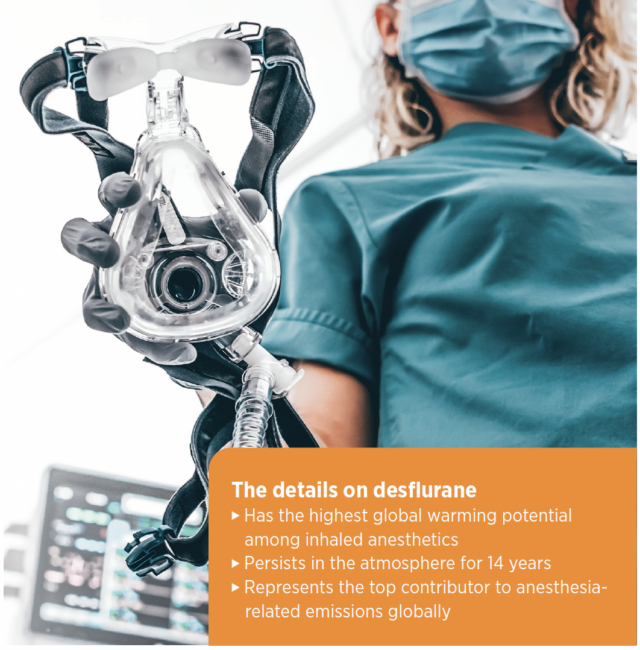
When Avery Palardy, MBA, MS, joined Beth Israel Deaconess Medical Center (BIDMC) in 2019 as a sustainability program manager, she knew removing desflurane from the formulary would have significant impact. “The anesthesia gas has 2,400 times the global warming potential of carbon dioxide,” she explains.
But environmental impact alone wasn’t enough. Ensuring patient safety— and clinician confidence—would determine whether the transition succeeded. Anesthesiologist Satya Krishna Ramachandran, M.D., Vice Chairman for Quality & Safety at Beth Israel Lahey Health, partnered with Palardy to explore and validate the clinical implications.
“The anesthesia gas has 2,400 times the global warming potential of carbon dioxide.”
Avery Palardy, MBA, MS


Ramachandran, M.D.
A departmental poll at Beth Israel Lahey Health revealed anesthesiologists preferred to retain desflurane. “People in leadership strongly supported continuing its use, while national and international consensus was to move away from it,” relays Dr. Ramachandran.
The solution: Treat the project as both a clinical safety investigation and a change-management initiative.
Dr. Ramachandran approached it from a patient safety perspective first. “What if it is a more polluting drug but it’s a safer drug for patients?” he asked. To ensure patient safety wouldn’t be affected, he gathered and reviewed the data. He conducted a retrospective analysis of tens of thousands of anesthesia cases, comparing safety outcomes between desflurane and sevoflurane. The results showed no significant difference. “That gave me great confidence bringing the recommendation to the executive decision group,” he says.
Pilot to proof
BIDMC launched a pilot in early 2020. Desflurane remained available, but clinicians had to retrieve it from the pharmacy and assemble the vaporizer themselves. “No one did that,” Dr. Ramachandran says. Meanwhile, he monitored for issues, such as delayed recovery or airway complications after sevoflurane use, and again found no differences.
The combination of clinical reassurance and real-world success paved the way for rollout across 11 additional hospitals within the system. “Clinician understanding of environmental issues—and our organizational commitments—made the transition easier,” says Palardy, now Executive Director of Climate & Sustainability.
The problem with desflurane
According to the Commonwealth Fund, healthcare accounts for 8.5% of U.S. greenhouse gas (GHG) emissions. The operating room contributes disproportionately, representing 5% of a hospital’s total emissions, with anesthetic gases making up 51% of OR emissions.
Sevoflurane has much lower environmental impact than desflurane and is less expensive. Desflurane has about 26 times the global warming potential as sevoflurane. It’s not easy to find projects that provide both cost savings and greenhouse gas reductions. As a Scope 1 emission—meaning the health system directly controls its release—this is a change that offers a practical opportunity for sustainability initiatives.
“The project must have a strong anesthesiologist involved; outsiders telling the department that they’re taking away desflurane will be met with a lot of resistance.”
Ethan Sims, M.D.

Change management
Eliminating desflurane isn’t simply a formulary update—it requires cultural change. “Awareness at the top level determines how these projects work,” Dr. Ramachandran says. Buy-in from executives, anesthesia leadership and clinicians across an organization is key.
“The project must have a strong anesthesiologist involved; outsiders telling the department that they’re taking away desflurane will be met with a lot of resistance,” says Ethan Sims, M.D., an emergency department physician at St. Luke’s Health System in Idaho, and Executive Director of Idaho Clinicians for Climate and Health.
Dr. Sims partnered with an anesthesiologist who was already working with the pharmacy to reduce desflurane usage, based on cost alone. “We decided to expedite the process and include the environmental impact of it,” Dr. Sims says. Several anesthesia leaders then spoke at the departmental meeting about it, improving knowledge and support. Still, about 20% of anesthesiologists were resistant to the change. Dr. Sims brought in a physician from Providence (Portland, Oregon) as outside expertise. Brian Chesbro, M.D., joined Dr. Sims in speaking to the group from an anesthesia and workflow perspective, answering questions and erasing their doubts. After a successful pilot, rolling out the initiative systemwide became easier.
 Measuring outcomes
St. Luke’s monitors desflurane usage on an active dashboard, using Epic and supply chain information to assist the team with focused communications. In addition to measuring cost and emissions reductions, St. Luke’s measures provider satisfaction. “The biggest concern people had was OR turnover time,” Dr. Sims says. They were concerned it would take longer for patients to wake after sevoflurane use; however, anesthesiologists provided no negative comments about sevoflurane’s workflow impact.
The next frontier: nitrous oxide reduction
Success with desflurane reduction is now inspiring organizations to address nitrous oxide, a potent greenhouse gas.
BIDMC’s study found 40%–50% leakage from its nitrous oxide systems. “It’s associated with a lot of nonclinical waste and has very toxic environmental impacts,” says Dr. Ramachandran. “It lasts more than 100 years in the environment. After desflurane, it is the No. 1 pollutant.”
Decommissioning the nitrous lines from systemic piping to e-cylinder machines in OR and labor rooms is more complicated. It involves logistical and project management issues: policy updates, education, workflows, procurement processes and tank movements.

“There’s no impact on patient care and safety, and it’s ultimately cost neutral,” says Palardy. “It’s an initiative that is purely environmental.” Since decommissioning their systemic piping, BIDMC has experienced at least a 90% reduction in nitrous oxide emissions.
It costs $10,000–$15,000 to decommission a facility’s nitrous system, says Dr. Sims, but the switch paid for itself in less than two years. St. Luke’s also saved several hundred thousand dollars by not installing a central nitrous oxide system in a new construction project.
More health systems are making the move
“A growing number of health systems have converted from desflurane or are starting the process to convert,” says
Jennifer Westendorf, DNP, RN, CNOR, AVP, Environmental Performance & Surgical Services at HealthTrust. There’s a big opportunity for ambulatory surgery centers to follow suit.
Ready to start? HealthTrust offers support documents in the Knowledge Library and a toolkit and evidence review is available from the Pharmacy team in the Member Portal. Members can also ask questions and learn from other health system experts about their sustainability initiatives by joining the HealthTrust Huddle. Additional questions? Email sustainability@healthtrustpg.com
Share Email Environmental Preferable Purchasing, ESG, Performance Improvement, Q1 2026, Surgery